Submission call-out for autistic teenagers

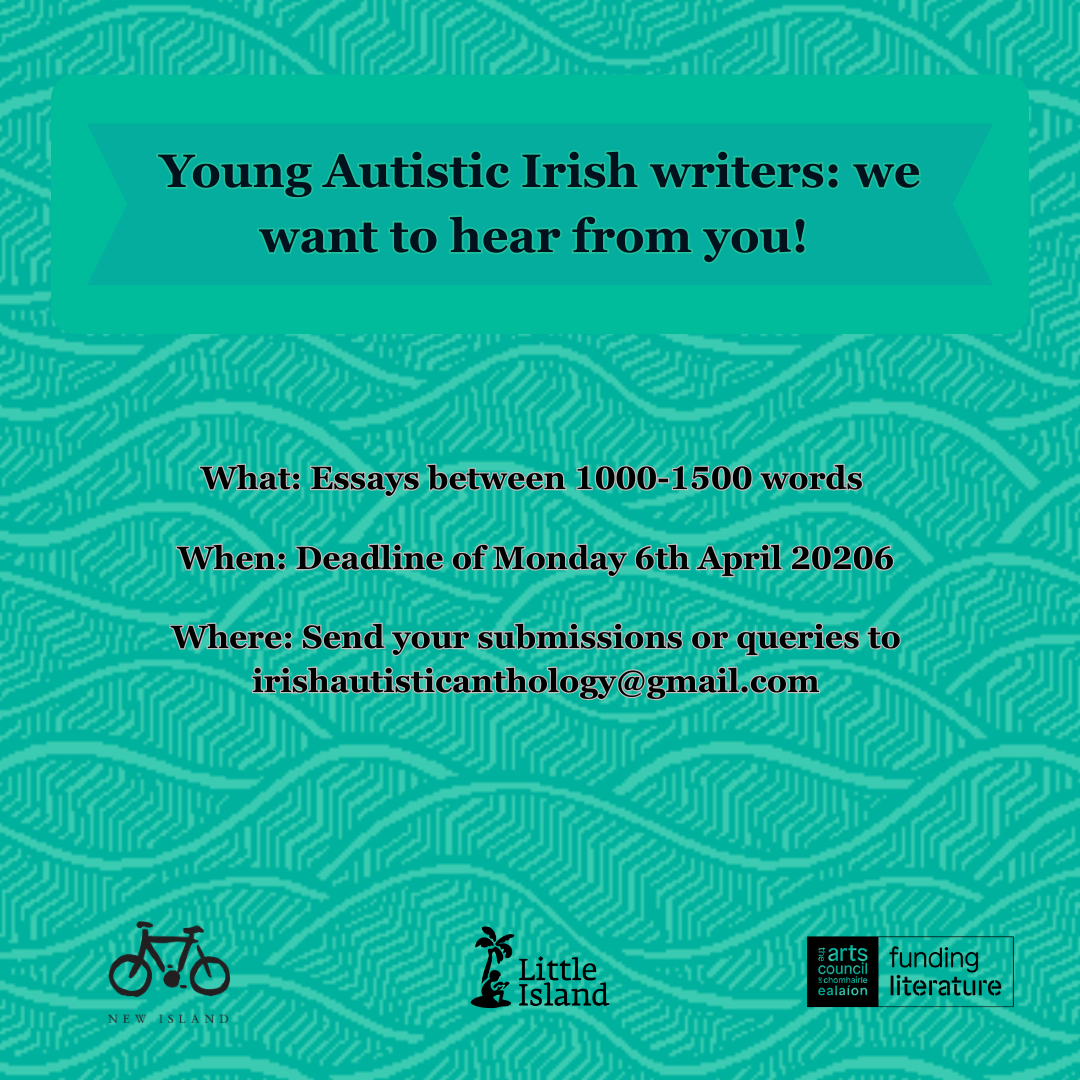
I’m looking for two personal essays by Irish autistic teenagers aged between 15-18 years for an upcoming anthology for teenage readers. The essay can be on anything do with autism, or how being autistic affects your life or something in your life.

Personal essays are written in the first person (i.e from your own perspective), and they are about your own experience. However, I invite you to have have creative freedom in how you write and format the essay- you can include a poem, bullet points, comic strips or whatever you want!

If you are unable to type (for example if you have co-occurring apraxia), feel free to get in touch about alternative methods to write the essay with my assistance. AAC Users and non-speakers are just as welcome to submit as anyone else, and I will provide any accommodations that are reasonable within my workload.

For any questions, contact me at irishautisticanthology@gmail.com

Deadline: 6th April 2026

About the anthology

The anthology will be published in 2027 by two Irish publishers working together; Little Island and New Island.

The majority of the essays will be written by autistic Irish adults, but we also want to include two teenage voices.

If your essay gets chosen

If your essay gets chosen, you may be asked to make some edits to your piece. This is standard practice in all books, and even the most experienced of writers will be asked to make edits to ensure a high standard of writing within the book.

The essay, along with your name, and a short few sentences about you (this is called your Biography) will appear in the book.

If your essay does not get chosen

When editing an anthology, I am looking at the book as a whole thing, so all the essays need to work well together. This makes choosing which essays to include really hard, as there might be lots of excellent essays, but I need to chose the ones that work best together. I need to avoid too much repetition of themes and concepts, and I need to try to ensure readers will stay hooked to the book from start to finish i.e that one essays flows nicely into the next.

If your essay does not get chosen, it does not mean it is a bad essay. It simply means the essay did not work as well an another essay did within the book as a whole. Don’t let this stop you writing or submitting your writing in future!

Upcoming Events for “Wired Our Own Way: An Anthology of Irish Autistic Voices”

Please note, all dates and times are subject to change. Please check closer to the date of the festival to confirm.

Write By The Sea Literary Festival, Kilmore Quay Wexford

Date: September 27th 2025

Time: 15:30

Red Line Literary Festival, Dublin

Date: 17th October

Time: 16:30

Upcoming Events for Wired Our Own Way (plus media links)

April Media:

I’ll be on Ireland AM on Monday 7th April at 8:45am, chatting about autism, my experience as an autistic woman, and of course, the book Wired Our Own Way; An Anthology of Autistic Irish Voices.

To read my interview in the Irish Times, see here: https://www.irishtimes.com/life-style/people/2025/03/30/niamh-garvey-being-diagnosed-with-autism-at-34-you-suddenly-get-the-language-that-explains-your-life/

To hear my interview on Today FM with Matt Cooper, on the Last Word show, see here: https://www.todayfm.com/podcasts/the-last-word-with-matt-cooper/wired-our-way-an-anthology-of-irish-autistic-voices

Cuirt Festival, Galway

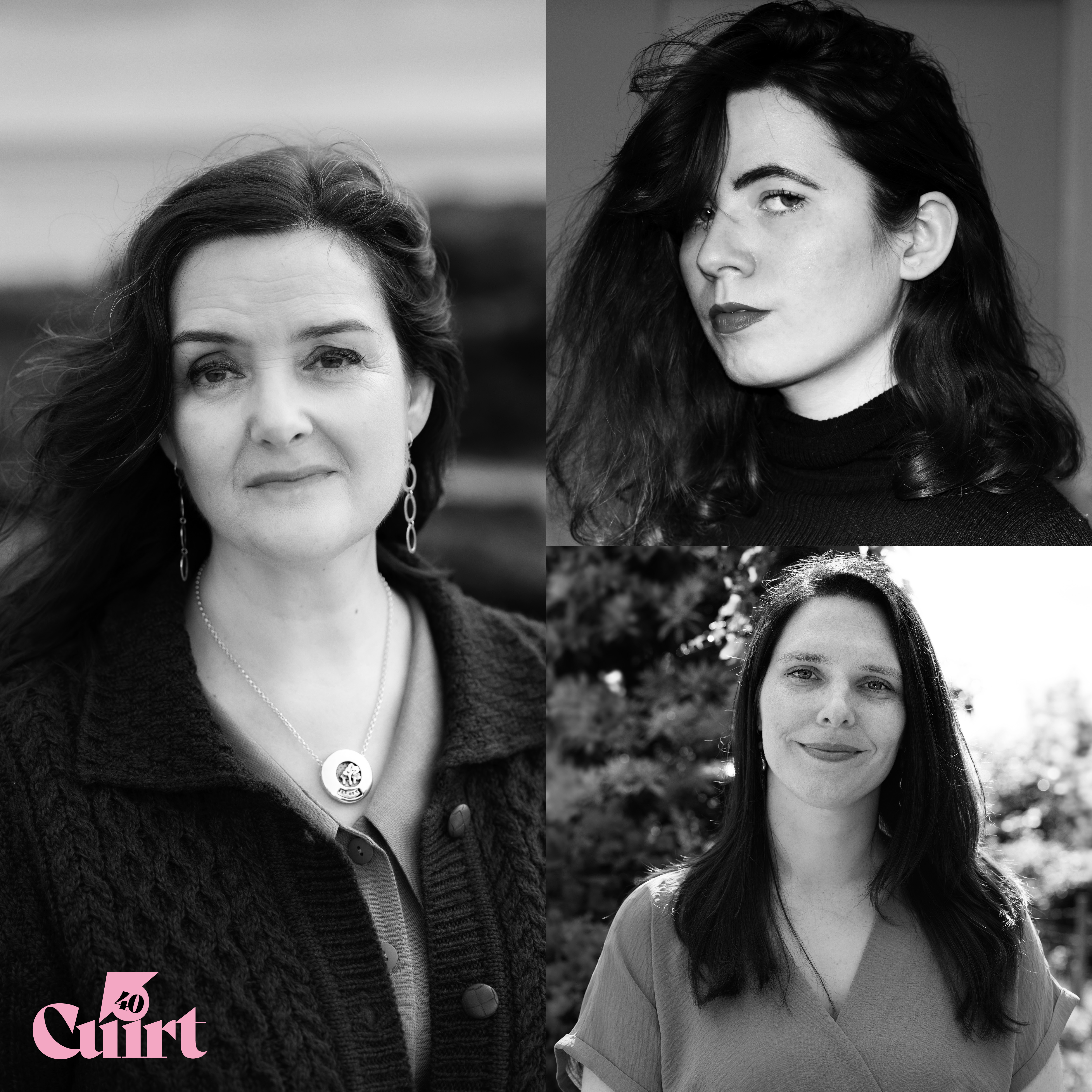
Event: Myself and two essay writers from the book, Nuala O’Connor and Naoise Dolan, will attend a panel at Cuirt, discussing Wired Our Own Way.

Date: 13th April 2025

Time: 2:30pm

Location: The Mick Lally Theatre

For more information and to buy tickets, please visit Cuirt’s site at https://www.cuirt.ie/whats-on/wired-your-own-way-with-nuala-oconnor-naoise-dolan-and-niamh-garvey/

International Literature Festival Dublin

Event: Myself, and contributors to the book Jen Wallace and Aisling Walsh will be chatting on a panel moderated by fellow contibutor Chandrika Narayanan-Mohan.

Date: 24th May 2025

Time: 16:00

Location: Merrion Square.

For more information and to buy tickets, visit: https://ilfdublin.com/whats-on/festival/wired-our-own-way-niamh-garvey-chandrika-narayanan-mohan-jen-wallace-aisling-walsh/

Making my book launch Autism-Friendly

Please note: All images have basic ALT text descriptions for visually impaired readers, but if anyone wants a more detailed breakdown of a photo (e.g the ones containing multiple books), please leave a comment and I will respond with a more thorough breakdown.

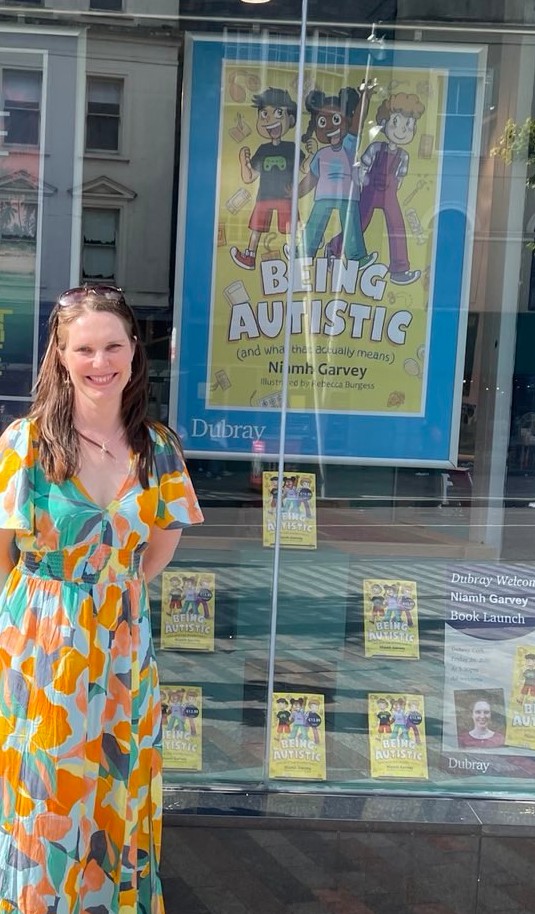
Photo of me standing outside Dubray bookshop's window.

In the window there is a large poster of my book "Being Autistic (and what that actually means)" plus a number of copies of the book.

The book launch of “Being Autistic (and what that actually means)” is done and dusted, and happily etched in my memory.

My favourite part of the evening was when a little boy told me “I’m autistic and I’ve never met another autistic person before”, and now here he was in a room full of autistic people, and feeling part of something bigger, and not alone.

Another special moment for me was when I was reading the section in my book on autistic stimming (which is a type of repetitive movement or behaviour that autistic people can do to regulate themselves) and the children started putting their hands up to tell me about their own stims. In that moment, in that room, autism was normalised to those children, which was one my biggest goals when I decided to write this book.

How I made the launch Autism Friendly:

The launch took place in Dubray bookshop, Cork. Dubray were wonderful to work with, and together we did the following to make this an Autism Friendly book launch:

1. I made a Visual Plan/ social story that showed what to expect at the book launch, and when to expect it. This included photos of the venue, and most importantly, explanations about where to go if anyone needed a quiet place, including the quiet corner or downstairs in the bookshop. This was the social story:

2. There was a Quiet Space prepared at the opposite side of the room to where the launch was happening. This quiet space had armchairs, a bean bag, cushions, fidgets, ear defenders and colouring. It was not possible to have the Quiet space in a different room, which would be the ideal type of Quiet space, but it was separated from the main launch space by multiple bookshelves.

Two armchiars, a bean bag, a floor cushion along with a table with fidgets, ear defenders and colouring

3. There was a variety of places to sit, including chairs, cushions, bean bags and blankets, which gave people a Sensory Choice of where they were most comfortable to sit (although a lot of adults had to stand as there was quite a big crowd!)

4.There were Fidgets and Ear Defenders available in abundance so anyone who wanted them could use them. Fidgets help a lot of neurodivergent kids to focus and listen (even if they look like they are distracted and not paying attention), and ear defenders allow noise sensitive kids to hear less background noise.

A selsction of figets toys: crochet ball, poppet, poppet ball, a yoyo, a rubix toy, and bendy fidget person

4. There were colouring sheets of illustrations from the book on clipboards (thank you to the illustrator Rebecca Burgess for making these for me!). The clipboards were to prevent the sheets tearing. This gave the children an Activity and Focus on arrival, so there was no pressure to communicate nor socialise if they did not want to.

photo of 2 copies of the book over 3 clipboards with colouring sheets

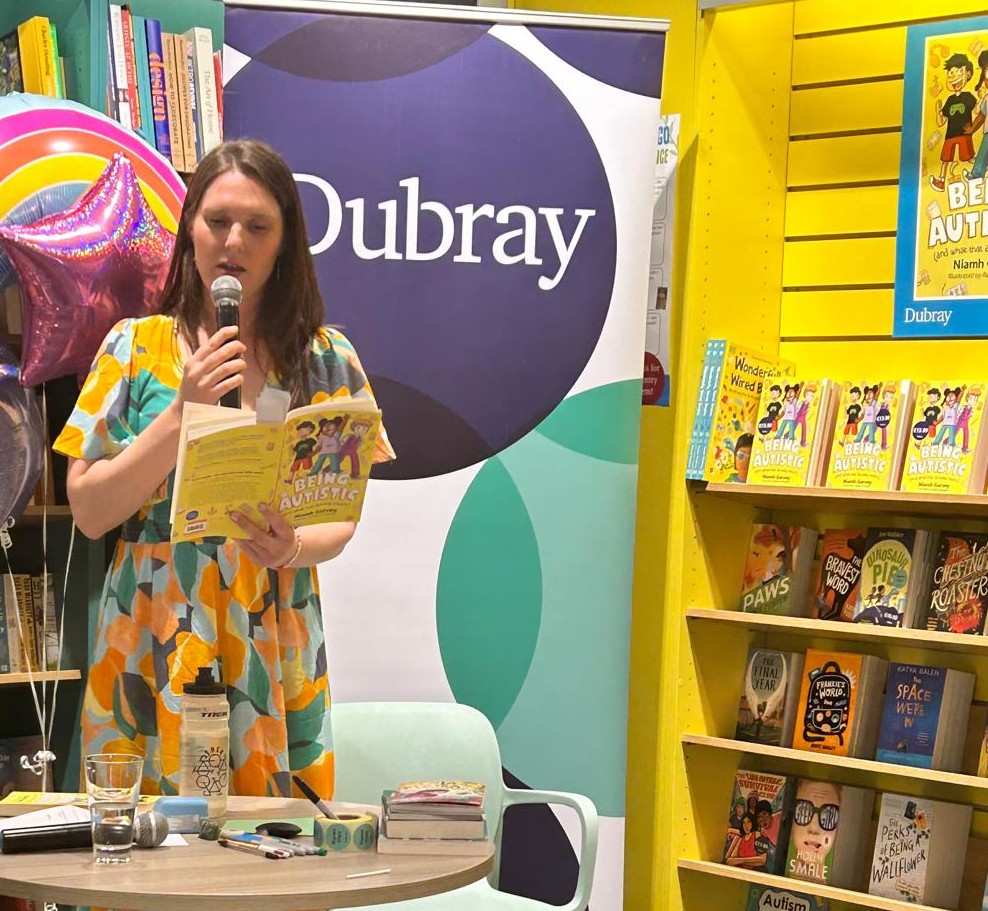
5. I considered the Attention Span of the age group, and kept the reading and speeches short as some of the autistic kids present were quite young. A good friend of mine, Eve McDonnell, who is a children’s author, introduced me, and kept it short and fun.

photo of me reading from a book with a microphone

6. People could choose from a Choice of sharpies or pens (including a choice of colour) for the book signing. I also made it clear that children did not need to get their book signed unless they wanted to. NB: While most of the kids loved the choice as it gave them a conversation topic when they reached me, some kids found the choice stressful. When I saw that a child was stressed by the choice, I chose for them by saying “How about I use my favourite one, that’s the blue pen…” which worked well. It was also really important not to rush the kids while making their choice, as autistic kids can take a bit longer to process language and choice.

7. There was a choice of drink flavours (cordial) and plain water to cater to different sensory tastes.

Extras: Displays of books with Neurodivergent Representation:

My children love when books have characters similar to themselves, as we probably all do. I asked Dubray could they do a display of kids books with autistic or neurodivergent characters, and books written by neurodivergent authors. Dubray did a brilliant display of books for children of all ages and interests, both fiction and non-fiction.

Book shelf of many kids books by neurodivergent writers or with neurodivergent characters

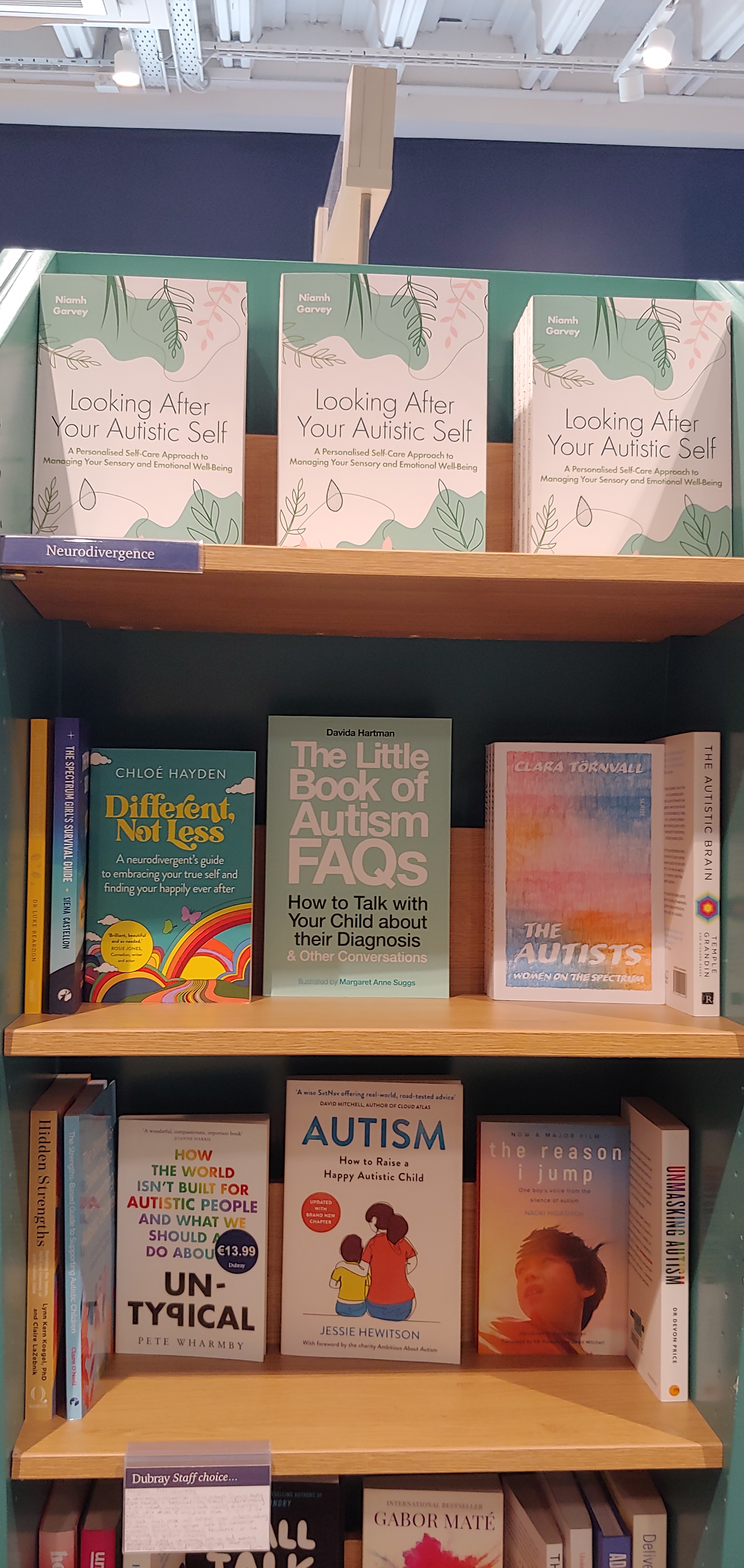
Not only did they do a kids book display but they did an adult one too.

Bookshelf of adult books on autism or by autistic writers

Making sense of the language: Neurodiversity, Neurodivergent and Neurodiverse.

I regularly hear people calling neurodivergent people “neurodiverse”, which is incorrect language, but an easy mistake to make. The language around this topic can be confusing, and I love that the word “neurodiversity” has entered society’s collective conversation, but I would love to see the correct language being used. It’s important that I make it clear that I don’t want to dissuade anyone from speaking about neurodiversity for fear of making a mistake. It’s okay to make a mistake! I simply hope that this article clears up any language confusion people might have.

What’s in this article?

Firstly, this article will explain what neurodiversity and neurodivergence mean.

Secondly, it will discuss how to use the correct language when referring to groups of people (neurodiverse, neurodivergent, neurotypical).

What is Neurodiversity?

A stylised multicoloured human brain consisting of a matrix of threads, shown in profile
Neurodiversity = Neuro (Brains) + Diversity (Differences)

Neurodiversity is the concept that the human race is made up of people with different types of brains, or neurotypes. Most people have neurotypical brains, but it is also natural and normal to have a brain that works differently to a neurotypical brain.

What is a Neurodivergent brain?

Neurodivergent = Neuro (brain) + Divergent (differs from the norm)

A neurodivergent brain is one that works differently to the more common, neurotypical brain. Some people call this “being wired differently”.

There are many different neurotypes that can make a person be neurodivergent, including Autism, ADHD, Dyslexia, Dyspraxia, Dyscalculia, etc.

Many neurodivergent people have more than one neurodivergent neurotype, e.g. a person might be Autistic and ADHD (which is often referred to as AuDHD), or ADHD and dyslexic etc.

Is it rare to be Neurodivergent?

Research has found that 1 in 10 people are neurodivergent (NIH, 2022), which shows that neurodivergence is not rare (but it is rarer than being neurotypical).

The correct language when referring to groups of people:

A circle of stylised block figures of people, holding hands. The people are variously coloured to indicate diversity.
A neurodiverse group is a group of people who have different neurotypes to each other i.e. more than one neurotype in the same group.

This is the most common group of people to be labelled incorrectly, in my opinion.

A group of people who are all neurodivergent, and have the same neurotype to each other, is a neurodivergent group. They are NOT a neurodiverse group, as there is no diversity of neurotypes within the group.

Examples:

  • A group of all autistic people = a neurodivergent group.
  • A group of all ADHD people = a neurodivergent group.

A group of people with different neurotypes to each other is called a neurodiverse group, even if there are neurotypical people in the group. This is because there is a diversity of neurotypes within the group.

Examples:

  • A group of neurotypical people and ADHD people = a neurodiverse group
  • A group of neurotypical people and autistic people = a neurodiverse group

If the people in the group have different neurotypes to each other, but are all neurodivergent, then this can be called either a neurodiverse group or a neurodivergent group.

Examples:

  • A group of autistic people and ADHD people = A neurodiverse or neurodivergent group
  • A group of ADHD people and Dyspraxic people = A neurodiverse or neurodivergent group.

A group of all neurotypical people is neither a neurodiverse nor a neurodivergent group. They are simply a neurotypical group.

References

NIH (2022) “Neurodiversity” Accessed on 6th June 2023 at https://dceg.cancer.gov/about/diversity-inclusion/inclusivity-minute/2022/neurodiversity

Website Under (Re-)Construction

In light of it have been several years since my last post on this blog, and given that much has changed in my circumstances and writing career, I felt it was appropriate to archive the old blog and start anew.

I’m currently in the process of rebuilding the site to refer to my current work, including information about my published book “Looking After Your Autistic Self” and my upcoming books for autistic adults and children.

Expect more soon!